Deterministic AI and Generative AI represent two opposite philosophical and mathematical approaches to computing. Deterministic systems rely on rigid, hard-coded rules to ensure the exact same outcome for a given input, while generative AI uses probabilistic reasoning to generate new content from inputs.
Deterministic AI: The Rule Follower
Deterministic computation traditionally fits the definition of automation, not intelligence. This is because it runs on explicitly programmed, human-defined rules ("if-then" logic). Whether deterministic AI even qualifies as a form of intelligence is up for debate. At its core, it merely follows a set of rules and does not possess the flexibility of intelligent systems.
Deterministic systems possess intelligence if they use AI models like LLMs, which are probabilistic, within an architecture that is deterministic. Probabilistic AI helps make an interpretation or judgement, while the surrounding deterministic workflow ensures that this information produces repeatable outputs through constraints and guardrails.
Deterministic systems possess the following characteristics:
Reliability
Deterministic AI never guesses or improvises. Its constitution is not to be useful, but to be accurate. Given identical inputs, deterministic AI will produce the same outputs every time.
For example, logic in a fraud detection system might stipulate that any transaction exceeding a set threshold (e.g. $5,000) originating from a foreign device within 24 hours of a password change be flagged as fraud.
Repeatability
Running the system with identical input will yield identical results across different sessions, times and machines. Also known as reproducibility, this ensures that exact conditions (code, datasets and hyperparameters) yield the same results when run again.
This is essential for debugging errors, enabling collaboration, maintaining model stability in production and ensuring compliance with governance and auditing regulations.
Auditability
Because its logic is predetermined, decisions made by deterministic AI are easily audited and traced. You can logically reconstruct every decision, making this method a strict requirement for regulatory, legal and financial compliance.
Additionally, outputs can be strictly validated and checked for errors, data types or syntax through hard-coded gates, allowing the system to automatically correct errors or reject faulty results.
"Its constitution is not to be useful, but to be accurate."
Deterministic AI is designed to follow rules and produce reliable, repeatable outputs. By its very nature, it cannot handle scenarios outside its specifically programmed rules. This makes it ideal for high-stakes applications where compliance, safety and exact accuracy are mandatory.
- Financial systems: Fraud detection rules, credit scoring.
- Manufacturing: Robotic process automation, quality control.
- Healthcare: Rule-based diagnostic logic.
Generative AI: The Creator
Have you ever asked ChatGPT the same question twice and received two different answers? Generative AI was initially developed to solve the computational challenge of modelling underlying data distributions to better understand real-world data such as speech, text and images.
Unlike traditional AI models, generative AI was not designed to classify or analyse inputs. Instead, it responds to prompts by creating computer-generated outputs.
GenAI uses neural networks that are inspired by human decision making. These networks are trained on vast datasets, progressively identifying patterns and learning relationships before using those statistical patterns to synthesise entirely new content.
Probabilistic Nature
Generative AI selects outputs from a spectrum of statistical probabilities. It never truly "knows" facts or rules. Instead, it predicts what should come next based on patterns it has previously observed.
When answering a prompt, it does not retrieve an answer from a database. Instead, it calculates the probability distribution for the next token. This is why identical prompts frequently produce different responses.
Creativity & Adaptability
Generative AI's priority is usefulness rather than absolute accuracy. Where there isn't a predefined answer, it creates one from statistical probability. This allows it to handle ambiguity, unstructured data and novel prompts with ease.
Because it relies on probabilistic sampling, identical inputs can produce different outputs. It is also prone to hallucinations because it is optimised for usefulness over factual certainty.
Contextual Adaptability
Generative AI can produce useful outputs regardless of the structure of its input. It excels at interpreting nuance, tone and open-ended instructions, making it particularly effective for applications such as intent detection in conversational AI.
Opaque Logic
The reasoning behind generative AI outputs is far more difficult to trace and audit. These systems operate as a "black box," making it nearly impossible to determine exactly why a particular word, sentence or image was generated.
Unlike traditional programming, where every decision can be traced through code, the logic inside a large language model is distributed across billions of parameters.
It is important to remember that generative AI is not designed primarily for accuracy. Much of today's criticism—including hallucinations, false information and unexpected outputs—comes from expecting it to perform tasks it was never optimised for.
Instead, generative AI excels at open-ended tasks where flexibility and human-like creativity are the objective.
- Content creation: Copywriting, image and video generation, marketing.
- Software development: Writing and debugging code.
- Customer service: Conversational chatbots for nuanced support.
Combining Deterministic and Generative AI for the Best of Both Worlds
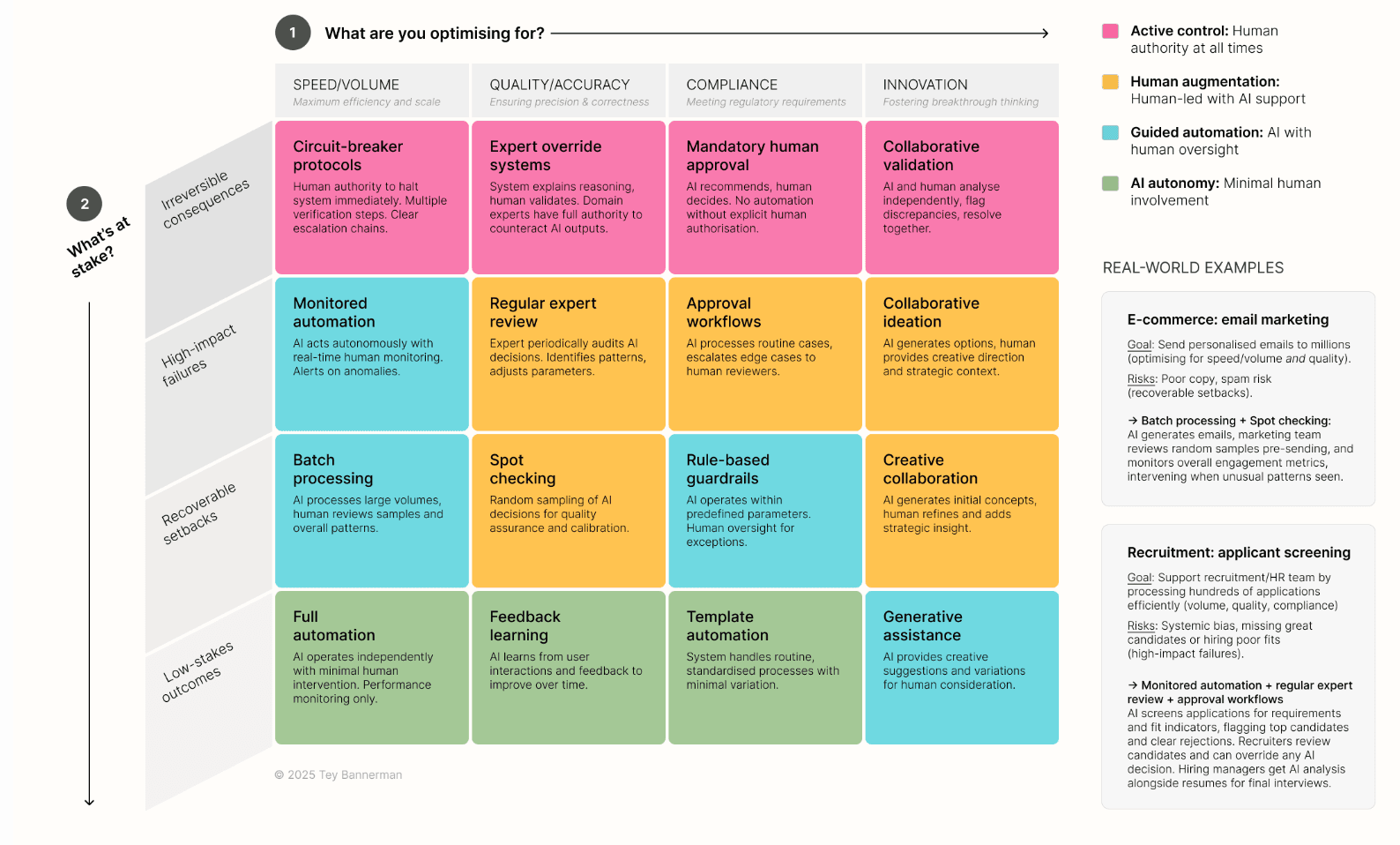
Rather than competing, these two approaches are increasingly combined into hybrid AI systems.
For example, a generative model may interpret a customer's complaint written in natural language, while a deterministic, rule-based system executes the refund or updates the database to ensure strict financial compliance.
Autonomous driving is another example. Modern vehicles use probabilistic perception systems to identify objects and predict movement, but when conditions become uncertain—such as fog, sensor failure or conflicting signals—they revert to deterministic safety protocols or hand control back to the driver.
Rather than viewing AI as a single type of intelligence, organisations should recognise that different AI systems have different strengths.
You wouldn't use a pool noodle to cut down a tree, so why would you use generative AI to flag fraudulent transactions?