Customer engagement is no longer an interpersonal challenge. Rather, it is a technological one. Organizations are slowly realizing that simply adding a wrapper to existing customer engagement strategies can’t fix their problems. To deliver truly scalable, hyper-personalized engagement, organizations require a system-wide shift.
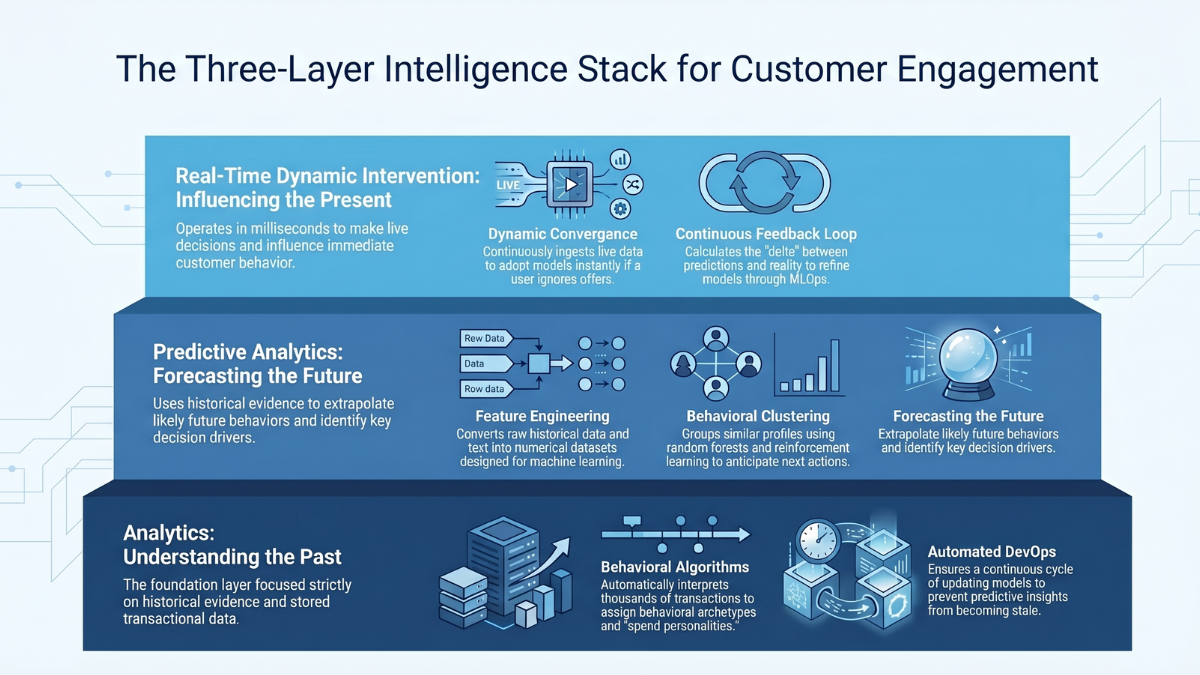
To achieve automated, behavioral customer engagement, three distinct layers must work together:
- Analytics (understanding behavior)
- Predictive analytics (anticipating behavior)
- Real-time dynamic prediction (influencing behavior)
Each layer builds on the one before it. Together, they move an organization from hindsight to foresight — and ultimately, to real-time intervention.
1) Analytics: Understanding the Past
Analytics is strictly backward-facing, focusing on historical activity and current evidence. This is where data is stored, processed and, most importantly, interpreted by algorithms.
Traditionally, this layer relied heavily on data scientists to manually analyze and extract meaning from datasets. But with the scale of modern transactional data, this approach is no longer practical. Today, algorithms are used to make sense of a user's history.
Analysis consists of several elements:
- Databases and Dashboards: Raw historical evidence is stored in databases and presented on reporting dashboards.
- Development Operations (DevOps): This automates the continuous cycle of updating data and models based on past errors. Without this automated development and operation cycle, predictive insights would immediately become out of date.
- Behavioral Analytical Algorithms: Because manually analyzing thousands of individual transactions is incredibly painful and complex, algorithms are deployed to automatically make sense of the data. ecosystem.Ai algorithms such as Spend Personality use behavioral archetypes to evaluate how a user previously spent their disposable income. These interpretations add behavioral features to datasets, offering interpretations of historical behavior. However, these insights do not yet contain anything predictive about the future.
Stored data that has been processed for meaningful insights then gets passed on to the next layer where predictions happen.
2) Predictive Analytics: Forecasting the Future
This layer shifts the timeline forward, using the historical evidence gathered in the analytics phase to extrapolate and predict future behavior. It can act as a tool to augment human intelligence, guiding employees on what to sell or say to a customer next.
Predictive analytics uses statistical models and machine learning techniques to identify likely future behaviors based on historical data, modelling customer behavior.The historical data is converted into specific data sets (often turning text into numbers) designed for machine learning models through a process called feature engineering.
This includes methods such as:
- Clustering : grouping similar behavioral profiles
- Random forests: identifying key decision drivers
- Reinforcement learning: adapting based on outcomes
- Automated Machine Learning: AutoML, to automatically determine the best algorithm to use based on how the data is shifting
Predictive analytics typically runs offline, but can be rerun at regular intervals (e.g. on the hour, determining what message to send a customer later that day).
Once data has been used to create predictive models, these can be used by real-time models to make decisions.
3) Real-time Dynamic Intervention: Influencing the Present
The intervention layer operates in real-time (for ecosystem.Ai, down to the millisecond) and takes on the role of decision-making. It relies on the models created by the previous two layers to act in the moment.
Several mechanisms work together to achieve this:
Dynamic Convergence
Instead of relying on static datasets, real-time systems continuously ingest live data. This allows models to learn and adapt immediately.
- If a user ignores an offer, the system adjusts in real time
- The next interaction is already more informed than the last
Algorithm Routing
Different situations require different decision strategies. The system dynamically selects the most appropriate algorithm based on context and objective:
- Broad optimization algorithms (e.g. the Ecosystem Rewards algorithm which uses Thomson sampling)
- Behavioral-specific models, such as:
- Loss aversion models, which emphasize urgency for users who dislike missing out
- Risk aversion models, which prioritize consistency over variability
You can view our complete list of behavioral algorithms here
Continuous Feedback Loop
Every outcome is compared to predictions:
- The system calculates the difference between prediction and reality (the “delta”)
- This feedback is fed back into the system
- Models are continuously refined through MLOps (Machine Learning Operations)
The Intervention Layer as the part of the algorithm stack that is exposed to the real-world. It gathers evidence of reality, and sends it back through the layers so the rest of the system can keep up. In the predictive analytics layer, outcomes are compared to predictions, calculating the "delta" or error in predictions.
The Business Payoff: Turning Engagement Into Revenue
The success of automated customer engagement systems should be set against one metric: impact on business performance. The end goal of every interaction is always at least one of the following: conversion, retention, and long-term value creation.
When built correctly, a layered engagement system transforms how businesses move customers through the funnel, from first awareness to sustained loyalty.
See how all three layers work together for various strategies
Real-Time Nudging and Retention Across the Full Stack
Retention is most effective when it is both informed by history and executed in the moment.
- Analytics shows which behaviors correlate with churn or loyalty
- Predictive models identify customers whose patterns match those trajectories
- Real-time systems act instantly when those signals appear
Sweetening the Deal with Behavioral Intelligence
Personalization becomes powerful only when it is grounded in a full behavioral loop.
- Analytics builds a detailed understanding of past spend patterns and preferences (e.g., spend personality shifts over time)
- Predictive models translate those patterns into expected future preferences
- Real-time systems test and refine offers instantly based on customer reaction
Augmenting Human Teams With a Unified Intelligence Layer
The same three-layer system also enhances human decision-making.
- Analytics structures historical behavior into understandable patterns
- Predictive models generate forward-looking recommendations
- Real-time signals refine those recommendations based on current context
Conclusion
The combination of all three layers creates a system that can continuously learn from evolving customer behavior. Customer engagement is no longer a matter of perfecting interpersonal skills, it is a technological puzzle — piecing together the best technologies and strategies to achieve specified business goals.