Banks have long been trying to solve the problem of customer engagement. In an industry that must balance trust, reliability and security with scalability, getting this right is both high stakes and notoriously difficult. The dawn of the digital era presented a promising opportunity to engage with customers at scale. Mobile banking apps allowed customers to manage their finance anytime, anywhere. Yet, when customers required more personalized support, they were left to scroll through FAQs and wait in line for the next available call agent.
AI-powered chatbots were an attempt to address this problem by allowing customers to ask questions and receive responses in real time. However, a survey conducted by Forrester Consulting showed that 75% of customers believe bots are unable to handle complex questions that require accurate responses. Additionally, negative interactions with chatbots drove a third of customers into the competition’s hands. The truth is that banks have not yet harnessed the true power of generative AI.
Configuring AI agents that can detect intent
Introducing the open-source Ecogentic Chat App
A satisfactory interaction starts with detecting intent. For LLMs to achieve this, they need defined categories, contexts and a pre-configured journey to follow. Our open-source Ecogentic Chat configuration, now available on our app, allows you to integrate controlled, auditable journeys into your environment.
Using our low-code workbench, technology professionals can easily build an entire customer journey. The Ecogentic Chat is made up of a sequence of ‘nodes’, including messaging, recommender and API nodes, each constituting a different stage in the Chat. Which node the customer lands on is determined by whether they fulfill a set of predefined criteria.
For example, you might specify that if a sentence includes the words “balance”, or “money”, the conversation jumps to the “balance node”. By setting up clearly defined categories (e.g. balance, transactions, products, and the elusive ‘other’) your model can relate a customer’s query to the correct context. The context is in turn bound by guardrails and routes, which determine where the conversation will lead next.
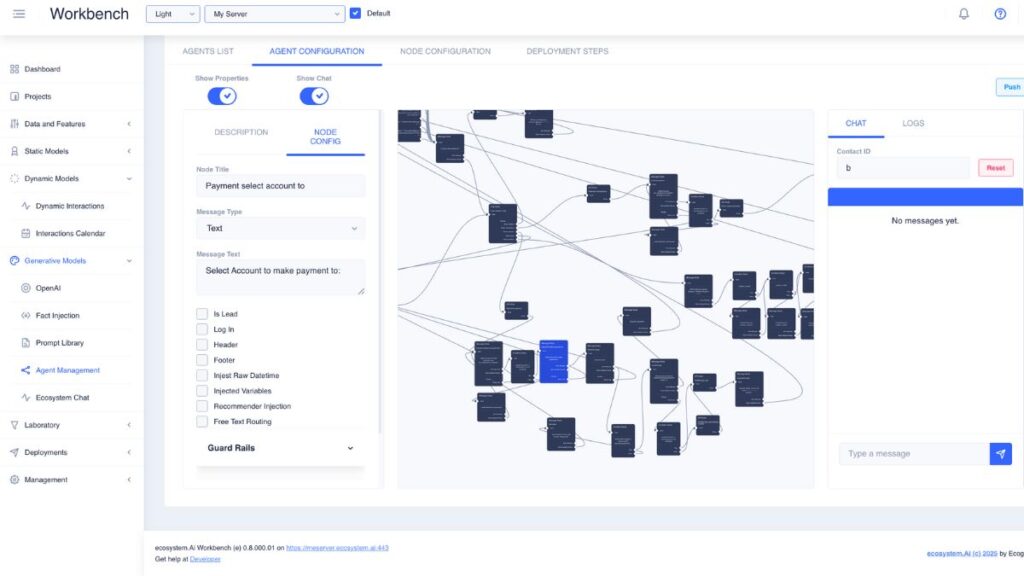
As described by our developer, Ramsay Louw, the Ecogentic journey resembles a “decision network” where you can define routes, lead customer journeys and ensure accuracy with Fact Injection.
Tools like context-setting not only ensure your model can properly detect intent, but also ensure only accurate and precise information is shared. Fact Injection, which forms part of context-setting, enables you to point the model towards specific data/information through an API call. This not only ensures that the information shared is relevant and helpful, but also in line with your security and compliance regulations.
A new way of banking
The Ecogentic Chat can also serve an operational function (doing work on behalf of the customer), which presents a fundamentally new way of banking. In applications, the customer journey is predetermined and unchangeable. Customers are left to navigate menu items and click through multiple screens to get to where they need to be. The Ecogentic Chat, however, lets the customer dictate the interaction. Ecogentic Chat, customers can make payments and transfer funds through a conversation, presenting a fundamentally new way of banking.
The Ecogentic Chat is entirely open source and downloadable as an app.
If you’d like to get testing on Apple or Android, send us an email at amy@ecosystem.ai and we will reply with the link!